

Story audio is generated using AI
Earlier this year, while hosting the hour-long talk show Tuesday Takeover on SAfm, I put what sounded like a simple question to the nation: who do you trust in South Africa — and why?
My guests were people working in very different institutions yet confronting the same fundamental question of credibility:
- Linda Ncube-Nkomo, CEO of the Nelson Mandela Children’s Fund; and
- Kaizer Kganyago, spokesperson for the National Prosecuting Authority.
At the time, reflecting on the question I posed, SAfm’s listeners also spoke of a profound fatigue with institutions that demand public faith yet fail to take accountability as seriously as they should. This past week, in the communities around Bronkhorstspruit, east of Pretoria, that simple question found a terrifyingly harmful answer.
Between October 7 and 21, 433 cases of gastrointestinal illness were reported in Bronkhorstspruit, Zithobeni, Dark City, Rethabiseng and Sokhulumi, and most of the patients were under four years of age. Think of what that means at home: a parent filling a bottle or a sippy cup with the water the municipality supplies, doing exactly what any of us would do, only to watch a toddler fall ill from it.
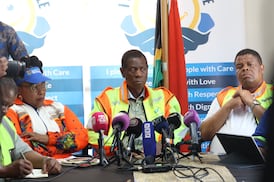
At a press briefing on Monday, the department of water and sanitation’s findings read like a police charge sheet. Problems with a chlorine supplier left water from the Bronkhorstspruit treatment plant unchlorinated from September 24 to October 14, while the plant continued to draw from a river severely polluted by sewage from failing upstream wastewater works and the city’s own broken pump stations.
As if that wasn’t enough, the pumps and sand filters were inoperable. Throughout it all, the Tshwane municipality failed to warn residents, as national water standards require. Read that again — failed.
Different cities, different governing parties, yet the same pattern: residents are the last to learn what affects them first
This was never about a single broken pipe. It was a chain of failures across maintenance, procurement, oversight and communication, and the final link is the one I cannot get past. Pipes and pumps can fail anywhere in the world; what a council owes its people when they do is the truth, and it must communicate it early enough. That failure to communicate is a failure of leadership.
That is why “Who do you trust, and why?” is such a consequential question. Trust is not affection for a party colour or a smiling face on a lamppost. It is the reasonable expectation that those responsible for your water will tell you when it is unsafe to drink. In Bronkhorstspruit, that expectation was broken long before the first child reached the clinic.
Bronkhorstspruit is the latest chapter, not the first one.
In February, at the height of Johannesburg’s water crisis, Gauteng premier Panyaza Lesufi spoke at a press briefing in Brixton to show that politicians also suffer, explaining that he sometimes booked into a hotel so he could have a bath. For residents hauling 20l containers home from water tankers, people who could never dream of paying for a hotel room just to wash, it was not solidarity but a confession of distance from Gauteng residents.
In eThekwini, after repeated beach closures due to sewage spills, it took a high court order last December to compel the city to publish E coli readings and issue public warnings.
Just this week, Hammanskraal residents in Tshwane described going without running water for about four weeks, relying on tankers or buying water for drinking and cooking. Some said they would not vote because they did not believe it would make a difference. This is a community still carrying the memory of the fatal 2023 cholera outbreak.
Inherited deterioration must be distinguished from present decisions, but inherited problems cannot excuse a failure to communicate with and warn residents
Different cities, different governing parties, yet the same pattern: residents are the last to learn what affects them first.
I have argued for years that public relations is what you do, not what you say, and nowhere is that truer than in a water crisis. During my short stint as a talk show host on SAfm, I argued that South Africa’s trust deficit is, at its core, a leadership deficit that manifests in communications, to contextualise why I wanted the nation to reflect on the question.
As a strategic communications consultant, I know that the institutions and public representatives that have earned public confidence in this country are those that have communicated consistently, honestly, and with intent. An honest warning before harm is communication at its most valuable; a polished apology after preventable harm is merely cosmetics applied to a wound.
As we approach the municipal elections, it is the second part of that question — the “why” — that deserves greater scrutiny.
Voters, I suspect, are reaching the same conclusion. In September, Ipsos’s Mari Harris described an electorate with little party loyalty, frustrated and demanding that parties show what they have done rather than make more promises. In the eNCA/MarkData survey, 68.7% of Johannesburg respondents said their city was poorly run, while 60.5% in Cape Town said theirs was well run. Both surveys predate Bronkhorstspruit, yet together they point to something deeper than passing anger: inherited loyalty is being tested by performance.
Importantly, Bronkhorstspruit also makes selective outrage impossible. Tshwane is governed by a coalition of the ANC, EFF and ActionSA under mayor Nasiphi Moya. It took over from a DA-led administration in October 2024 and says it inherited heavy debt and years of neglect. Inherited deterioration must be distinguished from present decisions, but inherited problems cannot excuse a failure to communicate with and warn residents.
Between now and November 4, every voter should reflect deeply on how many politicians and public representatives have got away with mere apologies and explanations, without real accountability
Earlier this year, I praised Moya’s accessibility in my article on digital silence. The same standard requires examining what happens behind that public presence, as I believe a responsive mayor needs an administration that detects danger, reports it and protects residents, especially in the event of a potential public health crisis. Personal visibility becomes valuable when it strengthens institutional responsibility; it cannot substitute for it.
So who do you trust?
Between now and November 4, every voter should reflect deeply on how many politicians and public representatives have got away with mere apologies and explanations, without real accountability. It is not good enough to hear accountability language such as “there will be consequences” or “heads will roll”.
Beyond municipal elections, South Africans need to define accountability standards and demand their consistent application. If we don’t, we must live with the fact that we brought endless apologies and platitudes from politicians and public representatives upon ourselves.
Furthermore, the task on November 4 is not merely to change who wears the mayoral chain and occupies council seats; it is to ensure that, whoever wins, a parent in Zithobeni, Soweto, Umlazi or even Fourways can turn on a tap without gambling with a child’s health. Safe water should not depend on a household’s ability to buy bottled water, and accountability should not hinge on whether the implicated politician belongs to a party we support. The standard loses its meaning the moment it is applied selectively.
Before politicians ask us to trust them with another five years, they should explain why we should trust them with a glass of water. Before we put a cross beside a party’s name, we should ask what it has done to earn the responsibility for our lives.
- Tshenkeng is CEO of Decode, a Pan-African reputation advisory and strategic communications firm, and author of ‘The South African Government Leaders on X Report’.
TimesLIVE




Would you like to comment on this article?
Sign up (it's quick and free) or sign in now.
Please read our Comment Policy before commenting.